

Yes, guards can often go on the gutter you have
The short answer is yes, often. A leaf guard sits over the gutter, so it needs a gutter underneath that is doing its job. If the run on your house is hung well, holds its line and does not leak at the corners, guards can usually be fitted to it after an inspection. If it does not, guards will not change that, and we would rather tell you before they go on.
That last point matters more than it sounds. A guard keeps leaves and debris out of the trough. It does not make a gutter maintenance-free, it does not stop debris from resting on top, and it does not fix a gutter that is badly pitched or badly hung. Put a guard on a tired gutter and you have a tired gutter with a lid on it. That is harder to check and harder to work on later.
So the real question is not whether guards can be added. It is whether the gutter you have is sound enough to take them. You can read about the guards themselves on our leaf protection page. The rest of this guide covers what sound means and how the decision gets made.
What makes an existing run sound
The first thing to check is the hangers. Each one should sit tight to the fascia and carry its share of the gutter. Warning signs are screws or spikes backing out, hangers that have slipped, or a gap opening between the back of the gutter and the board. A guard fastens to the gutter, so it can only be as secure as whatever the gutter hangs from. Spacing matters too. We hang ours roughly every 30 inches, but some runs have hangers as far as 4 feet apart, which leaves long stretches of gutter with nothing holding them up.
The second is sagging. Stand at one end and look along the gutter’s top edge. It should run in a straight, gentle line. Any dip holds water, and fine grit settles in standing water. With no guard on, you can see that and scoop it out. With a guard on, it sits out of sight.
The third is the corners. A miter is where two pieces of gutter meet, and corners are where an older gutter usually leaks first. Look for drips during rain, stains on the fascia or wall below a corner, or old caulk that has cracked and lifted. On our own gutter, each miter is hand-cut, fastened with five rivets and caulked inside. A corner that leaks today will still leak with a guard over it.
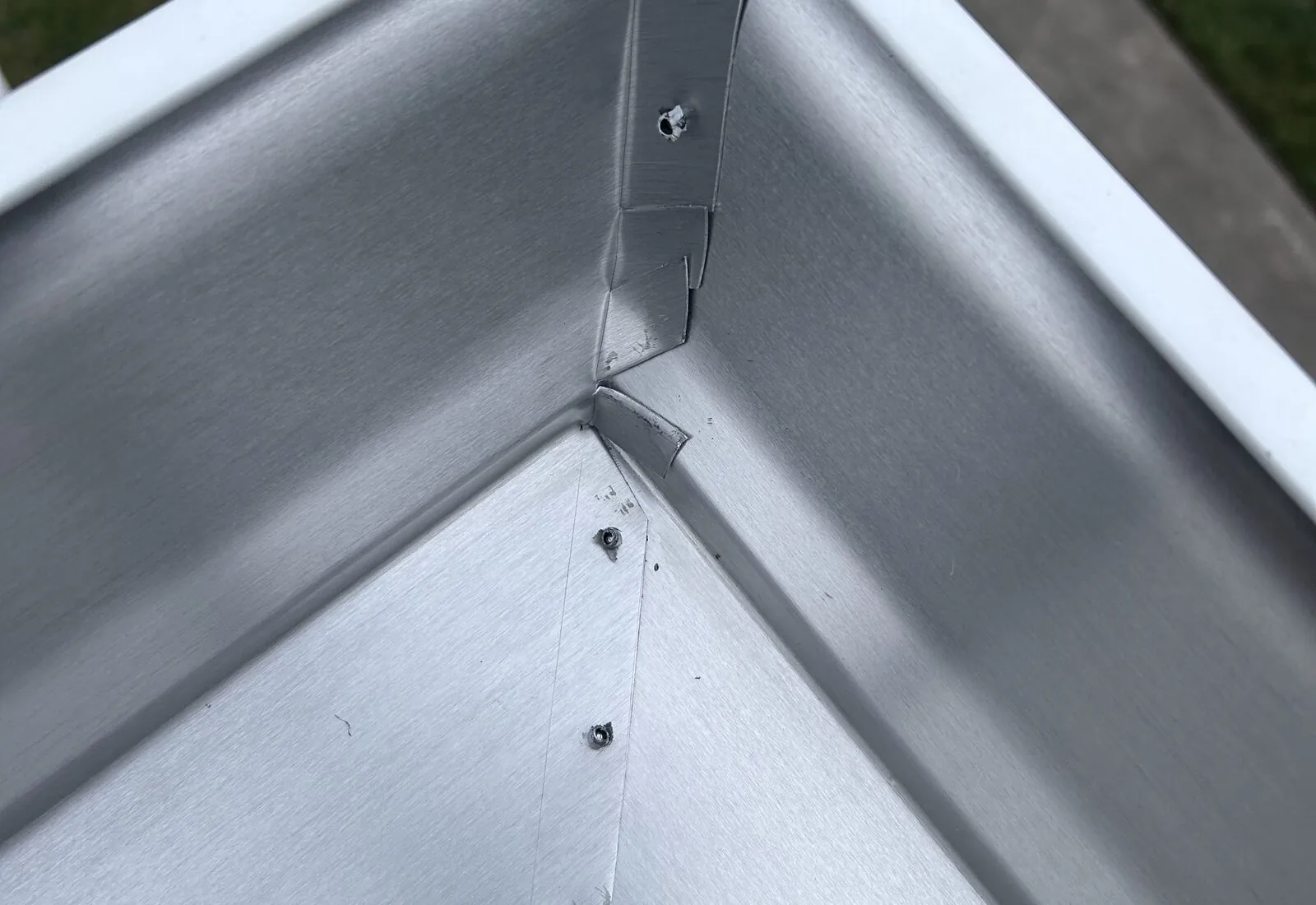
“A guard can only be as sound as the gutter it sits on.”
Why size and pitch matter for guards
A guard does not add capacity. Rain still has to get through or past the guard into the trough, and the trough still has to carry it to a downspout. Our standard is 6-inch seamless gutter because a 5-inch trade profile can be overwhelmed in a summer downpour. If your gutter already spills over at a roof valley or below a long roof face, a guard will not change that. In some cases it makes things worse, because water sheeting off the roof has one more surface to cross.
Pitch is the other half. A gutter should fall slightly toward each downspout so water drains instead of sitting. If the fall is too flat or runs the wrong way, water pools. Without guards you would notice it. With guards, the pooling and the silt it leaves stay hidden until the gutter overflows. A guard cannot correct pitch. Correcting it means taking the gutter down and hanging it again.
The downspouts are part of the same system. If they are too small or partly blocked, the gutter backs up no matter what sits on top of it. Our downspouts are 3x4 as standard, and we use 4x5 where the roof needs it.
When new seamless gutter makes more sense
Sometimes the inspection turns up more than one problem. The hangers are loose along most of the run, there is a sag in two places, a couple of corners are leaking, and the pitch is off. You could fix each of those and then add guards. But by that point the gutter has been taken apart and put back together, and it is often more sensible to replace the run and fit guards over new gutter in a single visit.
The same goes for sectional gutter with joints every few feet. Each joint is a place where a leak can start, and a guard makes them harder to reach. If you want to know more about how joints change things, our guide to seamless vs sectional gutters explains it.
New seamless gutter is formed on your driveway and cut to the exact length of each run. It is hung on heavy-duty hangers about every 30 inches, and every corner is hand-cut and riveted. The guards then go on a gutter whose size, pitch and hangers you know are right. Most homes are done in a single day.
None of that means your gutter needs replacing. If the run is sound, we will say so and quote guards on their own. We would rather tell you that than sell you a gutter you do not need.
What happens at the inspection
The inspection is part of a free estimate with no obligation. We come out, measure the roofline and walk the job with you. On each run we check the hangers and their spacing, look along the line for sags, check every corner for leaks, and note the pitch toward each downspout. We also note the gutter’s size against the roof above it, and where each downspout lets water out.
Some things are not ours to fix. Gutters and guards both need solid fascia to hang from. If the board behind the gutter is soft or rotten, that is a separate trade. We will point it out so you can have it dealt with first.
After that you get a written estimate based on what we saw and measured that day. It will say whether guards can go on your existing gutter, or whether it makes more sense to fit them with new gutter, and why. The person who quotes it is the person who installs it. If you would like someone to look at your gutters, you can book a free estimate.